Mobile Meter Reading: Energy Accounting Without Hardware
Mobile meter reading digitises energy accounting without hardware investment. How the EDM Toolbox replaces Excel workflows with audit-proof data.
Current state in industrial and real estate operations
In practice, energy accounting rarely begins with a platform. It begins with caretakers noting meter readings on clipboards, with accounting staff maintaining Excel lists, and with energy managers consolidating those numbers at month-end. The result is usually a patchwork of isolated solutions that supports neither a reliable energy KPI nor a robust consumption trend analysis.
With the rising requirements of **ISO 50001**, the **EED** and the **CSRD reporting obligation**, this approach is no longer sufficient. Companies need complete consumption data, unambiguous assignments and traceable capture processes – without having to invest in fully meshed sensor infrastructure or new submetering hardware. This is exactly where a mobile, hardware-free approach comes in.
> Four working days per quarterly report, just for consolidation – the typical effort that mobile capture reduces to a few hours.
Why mobile capture changes energy accounting
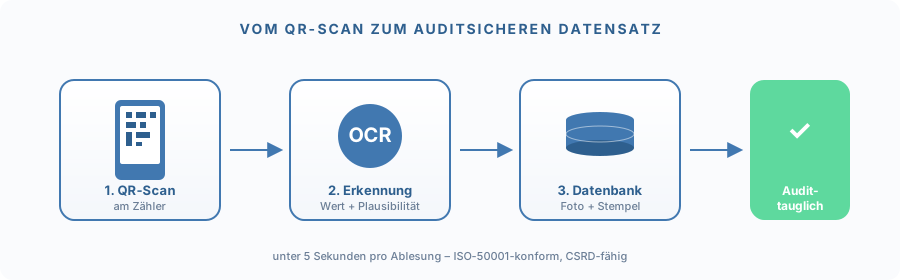
Mobile meter reading via a smartphone app closes the gap between analogue capture and digital evaluation. Readings are recorded directly in the field, tagged with geo, time and user stamps, and pushed into a central energy database. There they are immediately available for benchmarking, reporting and automated plausibility checks.
The shift away from Excel-based workflows is less a technology question than a question of process discipline.
Excel workflow vs. mobile capture in direct comparison
| Aspect | Excel-based | With mobile capture |
|---|---|---|
| Capture | manual, on paper at site | QR scan + OCR on smartphone |
| Transfer to system | retroactive, error-prone | immediate, validated |
| Quarterly consolidation | 3–4 working days | < 1 hour |
| Auditability | low, no photo evidence | audit-proof incl. photo |
| Data quality | ~5 % errors typical | < 0.5 % after plausibility check |
| ISO 50001 audit risk | high | low |
Relevance for ISO 50001 and CSRD
Both frameworks require systematic, traceable and recurring capture of energy consumption. Auditors review not only the figures themselves, but also the capture process.
A mobile solution with an audit-proof history and clear responsibilities meets these requirements without having to implement an additional, dedicated energy management system. This significantly lowers the entry barrier, especially for mid-sized companies and mixed-use property portfolios.
How mobile meter reading works in the EDM Toolbox
The EDM Toolbox deliberately focuses on a **hardware-free entry point**. This means: you need neither submeters nor radio modules, just the existing meters on site and a smartphone for the person taking the reading. The platform organises master data, reading cycles, evaluation and reporting in a single environment.
From photo to structured record
The reader scans the QR code on the meter or selects the metering point from a list. They then photograph the meter display.
The app recognises the value via OCR, compares it with the last valid reading and confirms whether the plausibility check was successful. Only then is the reading committed to the central database. If the OCR result is uncertain, the app suggests a manual correction – the original photo, however, remains stored as audit-proof evidence.
Roles and workflows
The platform distinguishes between **reader**, **energy manager** and **asset manager**.
- **Readers** only see the metering points assigned to them and are actively reminded of due readings.
- **Energy managers** maintain reading cycles, master data and tariffs and monitor the completeness of data.
- **Asset managers** receive consolidated reports per property, tenant or cost centre – without capturing any data themselves.
This clear role separation accelerates user acceptance and reduces follow-up questions from accounting.
Practical implementation in operations
Introducing mobile meter reading typically follows four phases, each lasting a few days. It is important not to choose the pilot scope too narrowly, so that meaningful insights into process quality can be gained.
First steps
1. **Inventory:** Capture all relevant meters in a unified list including location, medium and reading interval.
2. **QR code labelling:** Attach a QR code label to each meter to eliminate any risk of confusion or wrong assignment.
3. **Pilot phase:** Start with one property or one production line to sharpen processes and responsibilities.
4. **Roll-out:** Transfer the established processes to other sites afterwards. Adjustments from the pilot flow directly into the standard processes.
Typical pitfalls
Three recurring topics consistently appear in implementation projects and should be addressed early:
- **Master data quality:** Up-to-date meter numbers or medium assignments are often missing. A clean initial inventory saves many corrections later on.
- **Responsibilities:** Who reads which meter, and how often? Without clear allocation, data gaps will reappear.
- **Communication with readers:** Acceptance strongly depends on how the app is experienced in daily use. A brief onboarding session and a clear escalation path for technical issues are decisive for success.
Economics and growth path
The economic lever of mobile meter reading lies in two areas: reducing manual effort in capture and consolidation, and detecting consumption deviations more quickly.
Even with just a few dozen metering points, the implementation effort pays off within the first reporting period. Anyone who wants to automate capture later can retrofit individual meters or systems with sensor technology step by step – while master data, evaluations and reporting structures remain intact.
Conclusion
Mobile meter reading is not a substitute for fully automated submetering – it is the pragmatic entry into professional energy accounting that can start immediately without hardware investment.
Industrial operations and real estate asset managers thus gain a robust data base for ISO-50001-compliant reports, CSRD evidence and internal efficiency analyses within just a few weeks. The EDM Toolbox provides app, platform and visualisation from a single source – and can later be extended seamlessly with sensor technology as soon as the need arises.