Energy Data Capture in Buildings: AT and DE Rules in 2026
EnEfG, EEffG, HKVO, HeizKG and CSRD: which energy data obligations apply for buildings in Austria and Germany in 2026 – a compact overview.
Why the legal landscape in 2026 has become a data problem
Energy data acquisition in buildings is no longer a voluntary efficiency topic in Austria and Germany. With the EU Energy Efficiency Directive (EED) 2023, the EU Building Performance Directive (EPBD) 2024 and the Corporate Sustainability Reporting Directive (CSRD), three frameworks are moving simultaneously. National implementations – the **Energy Efficiency Act (EnEfG)** in Germany, the **Federal Energy Efficiency Act (EEffG)** in Austria and, since February 2026, the **Sustainability Reporting Act (NaBeG)** – translate these obligations into concrete duties for companies and property operators.
Anyone capturing energy data in 2026 is no longer doing so for the love of efficiency, but because auditors, financial auditors, funding agencies and authorities expect concrete evidence. The following overview summarises **what you must do**, **what you should do** and **at which level of granularity** the law expects it.
> Information status: May 2026. This is an editorial overview, not legal advice. Specific interpretations should be discussed with the relevant authority or a qualified legal professional on a case-by-case basis.
Contents
1. [The EU framework in two sentences](#the-eu-framework-in-two-sentences)
2. [What you must do in Germany](#what-you-must-do-in-germany)
3. [What you must do in Austria](#what-you-must-do-in-austria)
4. [AT and DE compared at a glance](#at-and-de-compared-at-a-glance)
5. [Which level of granularity is actually required](#which-level-of-granularity-is-actually-required)
6. [What you should do beyond the obligations](#what-you-should-do-even-without-a-current-obligation)
7. [How the EDM Toolbox covers these obligations](#how-the-edm-toolbox-covers-these-obligations)
8. [Conclusion](#conclusion)
The EU framework in two sentences
The **EED 2023/1791** requires member states to mandate energy audits and energy management systems above defined consumption thresholds. The **EPBD recast 2024/1275** demands national transposition by 28 May 2026, including harmonised energy performance certificates (scale A to G), digital building databases and – for large non-residential buildings – the Smart Readiness Indicator. The **CSRD** has been significantly streamlined by the Omnibus package of February 2026: only companies with **more than 1,000 employees and more than 450 million euros in revenue** cumulatively are now in scope; listed SMEs are excluded. The **ESRS E1 Climate Change** standard nevertheless continues to require evidence of energy consumption by source (renewable / fossil) and by location.
What you MUST do in Germany
EnEfG – energy management system and action plans
The EnEfG has been in force since 18 November 2023. It tiers obligations by the average final energy consumption of the last three years.
| Addressee | Threshold | Obligation |
|---|---|---|
| Companies | over 7.5 GWh/year | Energy management system to ISO 50001 or EMAS |
| Companies | over 2.5 GWh/year | Published action plan |
| Public bodies | over 3 GWh/year | ISO 50001 / EMAS from 30 June 2026 |
| Public bodies | 1 to 3 GWh/year | Simplified EnMS to ISO 50005 from 30 June 2026 |
A draft bill from April 2026 proposes a significant increase in corporate thresholds, with 23.6 GWh planned for the EnMS and 2.77 GWh for energy audits. The amendment has not yet been adopted, but it already shifts the strategic planning horizon.
EDL-G – energy audit for non-SMEs
Companies that are not classified as small or medium-sized enterprises (SMEs) are required by the Energy Services Act to perform an energy audit to **EN 16247-1** every four years, provided they remain below the EnMS threshold. A de minimis threshold of 500,000 kWh per year applies – below this, a notification to the BAFA suffices.
Heizkostenverordnung (HKVO) – remote-readable by end of 2026
The amended HKVO of December 2021 prescribes clearly staggered deadlines.
| Deadline | Obligation |
|---|---|
| since 01.12.2021 | New installations remote-readable only |
| by 31.12.2026 | Full retrofit of existing stock to remote-readable technology |
| once installed | Monthly consumption information to tenants and users |
The monthly consumption information (UVI) includes last month's consumption, the same month's value from the previous year and a comparison value from an average user. An annual statement remains additionally mandatory.
Metering Operation Act (MsbG) – mandatory smart meter rollout
The mandatory installation of intelligent metering systems has been significantly accelerated since the 2023 amendment. End consumers with an annual consumption between 6,000 and 100,000 kWh, plus all connections with controllable consumption devices such as heat pumps and wallboxes, are explicitly in scope. The full rollout runs in stages until 2032; by the end of 2025, an installation quota of 20 per cent in the mandatory group was set.
Building Energy Act (GEG)
The GEG requires the issuance of an energy performance certificate for new construction, sale, letting and leasing. Owners must retain the documents for at least **five years**. For newly installed heating systems from 2024 onwards, the **65 per cent renewable energy share** must be evidenced; hydraulic balancing must be documented by the executing company.
What you MUST do in Austria
Federal Energy Efficiency Act (EEffG) – audit or EnMS for large enterprises
The amendment of 15 June 2023 fully restructured the EEffG. The focus is on large enterprises – companies that are not SMEs. Approximately 2,000 businesses in Austria fall under this regime. Three core obligations apply:
| Obligation | Content |
|---|---|
| Audit or EnMS | Every four years an energy audit under Annex 1 of the EEffG, or an energy management system to ISO 50001 or EMAS |
| Reporting | Standardised short reports of audit and EnMS results to the Energy Efficiency Monitoring Office |
| Enforcement | E-Control as the competent authority, with sanctioning powers in case of violations |
SMEs are not directly obliged under the current version. They frequently fall into comparable acquisition duties indirectly via funding conditions, customer requirements or pressure from large corporate clients.
Heating and Cooling Cost Accounting Act (HeizKG)
In properties with remote-readable meters or heat cost allocators, the HeizKG has required **monthly consumption information during the heating and cooling period** since 1 January 2022. The information must be made available to users **free of charge**, including electronically. An annual statement remains additionally mandatory.
Smart meter ordinances (IME-VO, IMA-VO, DAVID-VO)
Austria has effectively completed the smart meter rollout. With **96.9 per cent** coverage, the EU target of 95 per cent by end of 2024 has been exceeded. The devices measure consumption in **15-minute intervals**, store data locally and transmit once daily to the grid operator. Consumers can access quarter-hourly readings from the next day onwards via the respective grid operator portal.
Sustainability Reporting Act (NaBeG)
The NaBeG was adopted by the National Council on 21 January 2026, confirmed by the Federal Council on 5 February 2026 and applies retrospectively from 1 January 2026. First wave: approximately 120 large, mostly capital-market-oriented companies with more than 1,000 employees and more than 450 million euros in revenue. The report must follow ESRS – including **ESRS E1** with location-specific energy consumption and Scope 1 / 2 emissions – and is subject to external assurance.
AT and DE compared at a glance
| Area | Germany | Austria |
|---|---|---|
| EU framework | EED, EPBD, CSRD | EED, EPBD, CSRD |
| EnMS / audit for large enterprises | EnEfG above 7.5 GWh (EnMS), above 2.5 GWh (action plan), otherwise EDL-G audit | EEffG: audit or EnMS every 4 years, ~2,000 large enterprises affected |
| Remote-readable heat meters | HKVO – mandatory retrofit by 31.12.2026 | HeizKG – monthly UVI on existing remote-readable installations since 2022 |
| Smart electricity meters | MsbG – mandatory installation from 6,000 kWh/year ongoing, full rollout by 2032 | IME / IMA / DAVID ordinances – rollout effectively complete at 96.9 per cent |
| Building energy certificate | GEG – EU-harmonised A–G from May 2026 | OIB Guideline 6 + EAVG, EU-harmonised A–G from May 2026 |
| Sustainability report | CSR Directive Implementation Act, significantly streamlined post-Omnibus | NaBeG since 01.01.2026, wave 1 approximately 120 companies |
| Enforcement / authority | BAFA, Federal Network Agency | E-Control, Monitoring Office |
Which level of granularity is actually required
On paper, the rules often read abstractly. In practical data acquisition, they boil down to four very concrete levels of granularity:
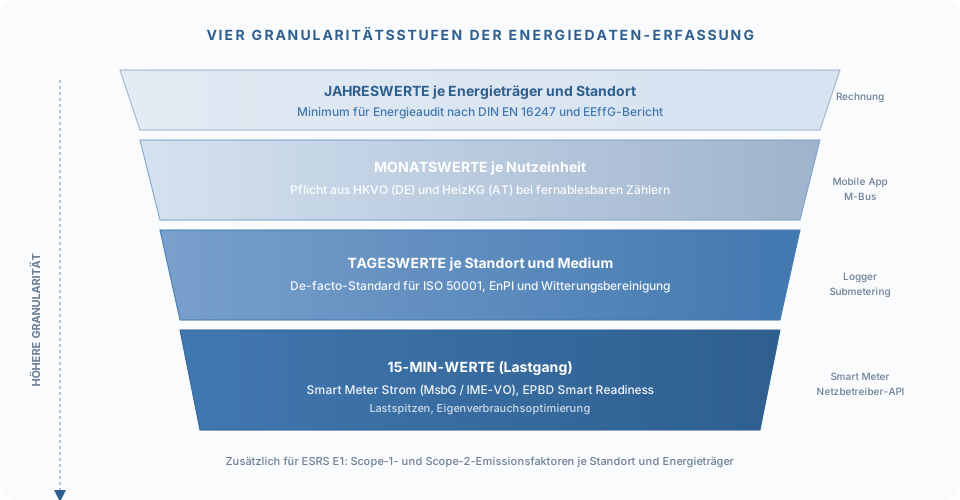
1. **Annual values per energy source and location** – the minimum for EN 16247 energy audits and EEffG reporting. Sources: supplier invoices, calibrated main meters.
2. **Monthly values per usage unit (apartment, tenant, area)** – mandatory under HKVO and HeizKG as soon as remote-readable meters are installed. Source: M-Bus, radio, OCR photo capture during transition.
3. **Daily values per location and medium** – the de facto standard for ISO-50001 energy KPIs, weather correction and plausibility checks. Source: data loggers, smart meters, submetering.
4. **15-minute values (load profiles)** – mandatory for smart meters in the electricity domain (AT and DE for intelligent metering systems), de facto required for peak load management, self-consumption optimisation and EPBD Smart Readiness.
Anyone seriously addressing ESRS E1 also has to maintain **Scope 1 and Scope 2 emission factors** per location and energy source – including country-specific electricity mix factors that update annually.
What you SHOULD do, even without a current obligation
Four recommendations from practice that come up in almost every discovery conversation:
1. **Capture data early.** Operating at 2 GWh/year is the right time to build structures – not when the threshold is breached and audit pressure kicks in.
2. **Submetering driven by economics.** Blanket full coverage rarely pays off. The smarter approach is a cross-media inventory and targeted retrofit at points where consumption drivers have been identified.
3. **Set up roles early.** EnMS and audit requirements demand clear responsibilities. Anyone clarifying this only during the audit has already lost.
4. **Think ESG-reporting-ready.** Asset managers, tier-1 suppliers, foreign corporate clients and banks increasingly demand location-specific energy data regardless of legal obligation. Anyone lacking the data will lose contracts, credit lines or funding.
How the EDM Toolbox covers these obligations
The EDM Toolbox is designed as a platform for energy data acquisition, energy accounting and ISO-50001-aligned energy management. It covers the four granularity levels as follows:
| Granularity level | Mechanism in the EDM Toolbox |
|---|---|
| Annual and monthly values | Mobile capture with photo evidence, OCR and plausibility checks |
| Daily values | Interfaces for M-Bus, Modbus, OPC-UA, KNX, BACnet, LoRaWAN, NB-IoT |
| 15-minute load profiles | Import from grid operator portals for sites with smart meters |
| Reporting layer | EnPI, weather correction to VDI 3807, country-specific CO₂ factors |
Conclusion
2026 is the year in which the regulatory mood crystallises: Germany debates the EnEfG amendment, Austria adopts the NaBeG, the EPBD transposition deadline ends, and the smart meter rollout is running at high pace on both sides of the border. Anyone capturing energy data in buildings is no longer doing so for convenience, but because three independent audit regimes – energy audit, ISO 50001 certification and sustainability assurance – each demand reliable numbers.
For energy managers, facility managers and asset managers this means: a fragmented data base consisting of Excel, supplier portals and WhatsApp photos is no longer a viable model. The EDM Toolbox covers the obligations described above in a single platform – with the option to start hardware-free and gradually expand to automated sensor infrastructure.